Genre 6

Bibliography:
DiCamillo, Kate. Flora and Ulysses. By K.G. Campbell. Massachusetts Candlewick Press, 2013. ISBN 9780763676711
Plot Summary:
Flora is a young pre-teen who, much to her mother's dismay, is obsessed with comics. She sets off on an adventure beginning with watching a squirrel get sucked up by a vacuum cleaner. Her new squirrel friend Ulysses turns into a superhero and sets off with Flora in this exciting story.
Flora is a young pre-teen who, much to her mother's dismay, is obsessed with comics. She sets off on an adventure beginning with watching a squirrel get sucked up by a vacuum cleaner. Her new squirrel friend Ulysses turns into a superhero and sets off with Flora in this exciting story.
Critical Analysis:
Flora is a likable character that a reader will immediately care about and have a possible connection. Right away, Flora says, "She was very busy. She was doing two things at once. She was ignoring her mother, and she was also reading a comic book." Every young pre-teen feels angst towards their parents at one time or another. DiCamillo has set this book up to first have the readers feel that pull towards liking Flora. As the reader continues on, there are several connections they can pull from. "Talking to my baby doll? She felt a flush of outrage crawl up her cheeks. She was ten years old, almost eleven!"
The plot of the story is interesting, yet still believable. Even when the strange things are happening the author has Flora questioning herself, "Is this really happening? This can't be." The story of the squirrel becoming a super hero is creative and will keep all readers interested to find out what happens.
Cambell's illustrations positively assist with the reader's visualization of the settings. The pictures are pencil drawings that descriptively show the characters feelings. DiCamillo paints a descriptive picture of the backyard in the beginning of the story when the vacuum is sucking up Ulysses the squirrel. " Flora ran through the tall grass and cleared the fence between her yard and the Tickhams' in a single bound."
The author's writing style is consistent throughout. Children of divorced parents will relate to what Flora has gone through. "Before the divorce, before her father had moved out of the house...he had often sat beside her at night and read aloud to her." The reader can hear the sadness in Flora's thoughts as she thinks about what life was like before their divorce.
Review Excerpts:
Newbery Medal
From Kirkus Reviews: "Original, touching and oh-so-funny tale starring an endearingly implausible superhero and a not-so-cynical girl."
From Publishers Weekly: "Despite supremely quirky characters and dialogue worthy of SAT prep class, there's real emotion at the heart of this story involving two kids who have been failed by the most important people in their lives: their parents."
From Booklist: "Newbery-winner DiCamillo is a master storyteller not just because she creates characters who dance off the pages and plots, whether epic or small, that never fail to engage and delight readers."
Connections:
Conduct a research project on squirrels.
Have students create their own comic strips.
Do a character map on Flora and discuss ways she could handle her problems in life.

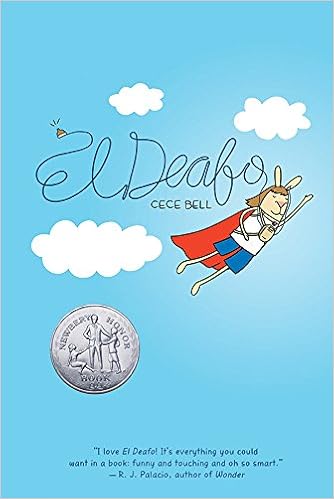
Plot Summary:
CeCe gets meningitis as a small child and as a result is now deaf. The story portrays the challenges that this brings into her life and how she overcomes them.
Critical Analysis:
Bell adequately describes the internal struggle that CeCe endures during her young and adolescent years as a deaf child. She is able to develop the character in a believable, yet humorous way. One of my favorite line is in the beginning of the book when she's holding a card up to her dad stating, "Mustaches and beards are bad news! (Sorry, Dad!)." Bell does an excellent job of lightening up the sad mood that can permeate throughout this book due to character's situation. She does a great job of changing the dialogue throughout the book to reflect t CeCe aging.
This story is such an engaging story while retelling events that actually happened in Bell's life. The reader is engaged, wondering what will happen at the end of the book. Will she find happiness as a deaf child? It is comforting at the end of the story when the author reveals that she is the little girl and that she "is no longer ashamed of being deaf, nor do I think of myself as someone with a disability."
Lasky's colorful comic book illustrations help stage the setting for El Deafo. The setting is consistent with the story line. The way that Lasky has drawn the school and doctor's office is very much an accurate portrayal of present time. Laskys and Bell have also taken note as CeCe gets older and the school room changes into bigger desks and different chalkboards.
The theme of this story arises naturally. It is a story of acceptance and perseverance. The reader will ultimately want to cheer CeCe on as she goes through her struggles in her life.
Bell is able to create a heart breaking story about her own personal struggles of living with a hearing aid. It will make you reminisce in your own memories of peers that went through these same struggles. After reading this book it has made me reflect on my hearing impaired students. When a good book has you reflecting for several hours, you know it's a good one!
Review Excerpts:
Newbery Medal Award
From Publishers Weekly: "Cece's predilection for bursting into tears at the wrong time belies a gift of resilience that makes her someone readers will enjoy getting to know."
From Horn Book: "This memoir is thus exceptionally informative and entertaining in relation to some aspects of deaf communication, but, most centrally and powerfully, it is exceptional for its perceptive, indomitable protagonist and complex story of friendship, growth, and classroom and famly dynamics."
From Kirkus: "A humorous and touching graphic memoir about finding friendship and growing up deaf."
Connections:
Have students draw and write their own comic books about their weekend.
Talk about what meningitis is and discuss different forms of hearing loss.
Talk about practicing empathy with children of hearing loss and show them videos of students/adults hearing for the first time after getting implants.
Talk about why some people don't like the word "handicapped"- talk about other words or ideas that would be better to use.
Bibliography:
Anderson, Laurie Halse. Speak. New York, 1999. ISBN 9781429997041
Plot Summary:
Melinda has had a traumatic ending to her summer. Anderson takes us on a journey of Melinda trying to find her voice in high school after the unthinkable has happened to her.
Critical Analysis:
Anderson has developed a relatable freshman in high school character, Melinda. "It is my first morning of high school. I have seven new notebooks, a skirt I hate, and a stomachache." This exemplifies what most teenagers are feeling on the first day of school. The reader will immediately fall in love with her cynical view on high school and yearn to find out what happened that summer. Anderson humorously and effortlessly shows the emotional growth that Melinda goes through from August to May.
The reader does not know what has caused Melinda's anguish until halfway through the story. Through the beginning, she is still paving the way and showing all of the drama that Melinda has to endure her first semester of school. She is not only dealing with the mysterious drama from the summer, but her own parent's habitual fighting. All of the events are relatable and believable to most teenagers.
The setting is clearly set at school and at home. Anderson is able to set the scene notably in the art room. "The classroom is at the far end of the building and has long, south-facing windows. The sun doesn't shine much in Syracuse, so the art room is designed to get every bit of light it can. It is dusty in a clean-dirt kind of way. The floor is layered with dry splotches of paint..." This helps set the somber mood of the entire book.
The theme of Speak comes out naturally near the end of the book. It is paramount for young readers to understand the importance of speaking up and sharing your voice. This book teaches the significance of that idea and the consequences of not expressing your thoughts.
Anderson's humorous metaphors are prolific in this daring novel. The reader can hear her dry sense of humor throughout. "Either Ivy has a great force field, or my laser vision isn't very strong." Who hasn't stared at someone to get them to look at you? Adults and youth alike can understand that. Anderson also makes the reader feel empathy and sadness for Melinda. "The salt in my tears feels good when it stings my lips."
Anderson has done an amazing job of showing the consequences and emotional impact of rape. This is a sensitive topic and she even goes into detail of the importance of talking about it at the end of her book. She reminds readers, "Reading and discussing books is one of the most effective ways to get teens to think through and learn about the challenges of adolescence. Our children cannot afford to have the truth of the world withheld from them."
This story is a raw, eye opening, inside perspective of the emotional ramifications of being raped. I think it is a must read for every teenager.
Review Excerpts:
Golden Kite Award for Fiction
Michael L Printz Award
From The Horn Book: "An uncannily funny book even as it plumbs the darkness, Speak will hold readers from first word to last."
From Library Journal: "A story told with acute insight, acid wit, and affecting prose."
From The Publisher: "Melinda's voice is distinct, unusual, and very real as she recounts her past and present experiences in bitterly ironic, occasionally even amusing vignettes.
Connections:
Discuss what figurative language is and have students create their own.
Have students do an "About Me" collage to increase classroom connections with one another.
If students are at an appropriate age, show the Lifetime movie- Speak that is based on the novel.
Bibliography:
Bell, CeCe. El Deafo. By David Lasky. New York: Amulet Books, 2014. ISBN 978-1-4197-1217-3
Plot Summary:
CeCe gets meningitis as a small child and as a result is now deaf. The story portrays the challenges that this brings into her life and how she overcomes them.
Critical Analysis:
Bell adequately describes the internal struggle that CeCe endures during her young and adolescent years as a deaf child. She is able to develop the character in a believable, yet humorous way. One of my favorite line is in the beginning of the book when she's holding a card up to her dad stating, "Mustaches and beards are bad news! (Sorry, Dad!)." Bell does an excellent job of lightening up the sad mood that can permeate throughout this book due to character's situation. She does a great job of changing the dialogue throughout the book to reflect t CeCe aging.
This story is such an engaging story while retelling events that actually happened in Bell's life. The reader is engaged, wondering what will happen at the end of the book. Will she find happiness as a deaf child? It is comforting at the end of the story when the author reveals that she is the little girl and that she "is no longer ashamed of being deaf, nor do I think of myself as someone with a disability."
Lasky's colorful comic book illustrations help stage the setting for El Deafo. The setting is consistent with the story line. The way that Lasky has drawn the school and doctor's office is very much an accurate portrayal of present time. Laskys and Bell have also taken note as CeCe gets older and the school room changes into bigger desks and different chalkboards.
The theme of this story arises naturally. It is a story of acceptance and perseverance. The reader will ultimately want to cheer CeCe on as she goes through her struggles in her life.
Bell is able to create a heart breaking story about her own personal struggles of living with a hearing aid. It will make you reminisce in your own memories of peers that went through these same struggles. After reading this book it has made me reflect on my hearing impaired students. When a good book has you reflecting for several hours, you know it's a good one!
Review Excerpts:
Newbery Medal Award
From Publishers Weekly: "Cece's predilection for bursting into tears at the wrong time belies a gift of resilience that makes her someone readers will enjoy getting to know."
From Horn Book: "This memoir is thus exceptionally informative and entertaining in relation to some aspects of deaf communication, but, most centrally and powerfully, it is exceptional for its perceptive, indomitable protagonist and complex story of friendship, growth, and classroom and famly dynamics."
From Kirkus: "A humorous and touching graphic memoir about finding friendship and growing up deaf."
Connections:
Have students draw and write their own comic books about their weekend.
Talk about what meningitis is and discuss different forms of hearing loss.
Talk about practicing empathy with children of hearing loss and show them videos of students/adults hearing for the first time after getting implants.
Talk about why some people don't like the word "handicapped"- talk about other words or ideas that would be better to use.


Comments
Post a Comment