Genre Three- Poetry
Bibliography:
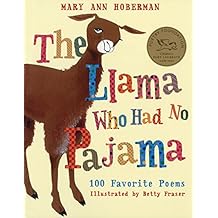
Hoberman, Mary Ann. The Llama Who Had No Pajama. by Betty Fraser. Boston: Sandpiper, 1998. ISBN 9780152055714
Plot Summary:
Hoberman covers varying topics in this playful and fun collection of poetry for children. The moods and tone change from poem to poem as you are taken on a journey through this book. A majority of the poems are short and have rhyme and rhythm throughout.
Critical Analysis:
Hoberman's use of several different literary terms is seen throughout this whimsical poetry book. "Clatter and Clacket!" is just one example of onomatopoeia. Alliteration can be found in the poem, "Permutations." It can be quite the tongue twister saying, "A flea flew by a bee. The bee to flee the flea flew by a fly."
Children of all ages will enjoy attempting to read these poems aloud. Adults will find a connection with "Hello and Good-by." It is as if the author is going through the different seasons of life, saying hello and goodbye. Siblings will relate to, "My sister saw a dinosaur." All siblings will say silly things at one point or another. Most of the poems have a silly edge to them.
The watercolor illustrations go hand in hand with each poem. Some poems only have a small illustration to accompany them. This allows the reader to use more of their own imagination. I would highly recommend this fun and entertaining poetry book.
Children of all ages will enjoy attempting to read these poems aloud. Adults will find a connection with "Hello and Good-by." It is as if the author is going through the different seasons of life, saying hello and goodbye. Siblings will relate to, "My sister saw a dinosaur." All siblings will say silly things at one point or another. Most of the poems have a silly edge to them.
The watercolor illustrations go hand in hand with each poem. Some poems only have a small illustration to accompany them. This allows the reader to use more of their own imagination. I would highly recommend this fun and entertaining poetry book.
Review Excerpts:
Poetry Foundation Award- Children's Poet Laureate 2008-2010
Gold Award Winner- 1998 National Parenting Publications AWards
Best Book of the Year- Child Magazine
From School Library Journal: Hoberman's rhythms are lively and agile, and her imagination and sense of humor are still in tune with young readers."
From Horn: "Although perhaps best taken in small doses, this collection of some forty years of Hoberman verse is a charmer."
Connections:
This can be a great starting point for beginning to write poetry. Have students write their own poems using this book as a guide.
Read other poems by Hoberman:
You Read to Me, I'll Read to you: Very Short Stories to Read Together
You Read to Me, I'll Read to you: Very Short Mother Goose Tales to Read Together
You Read to Me, I'll Read to you: Very Short Stories to Read Together
You Read to Me, I'll Read to you: Very Short Mother Goose Tales to Read Together
Bibliography:
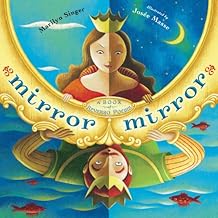
Singer, Marilyn. Mirror mirror: A book of reverso poems. by Josee Masse. Penguin Young Readers Group, 2010. ISBN 9780525479017
Plot Summary:
Mirror Mirror is a set of reverso poems. Reverso poems are poems told one way and then a completely different way offering unique perspectives on the characters. Famous story characters, including Goldilocks, Snow White, and Little Red Riding Hood, can be found throughout the collection.
Critical Analysis:
Slinger has rhyming words and a fun rhythm throughout these very unique poems. The reverso poem offers an alternative view of each character. Slinger cleverly writes the beginning and the end of each poem mirrored in each character set. "In The Hood" begins with Little Red Riding Hood's voice, "In my hood, skipping through the wood." The poem ends with the wolf's voice, "skipping through the wood in my hood." This technique forces the reader to stop and think about what the author is trying to do and also encourages the reader to view the story in a different light.
There is a rhythm to the poems, however there are no rhyming words. The language is easy to follow for young children with simple words. Masse's illustrations are beautiful and elegantly tell both sides of the poems. The pictures have a divider showing the two different sides. The timeless characters allow this book to appeal to both the young and old at heart.
Slinger has rhyming words and a fun rhythm throughout these very unique poems. The reverso poem offers an alternative view of each character. Slinger cleverly writes the beginning and the end of each poem mirrored in each character set. "In The Hood" begins with Little Red Riding Hood's voice, "In my hood, skipping through the wood." The poem ends with the wolf's voice, "skipping through the wood in my hood." This technique forces the reader to stop and think about what the author is trying to do and also encourages the reader to view the story in a different light.
There is a rhythm to the poems, however there are no rhyming words. The language is easy to follow for young children with simple words. Masse's illustrations are beautiful and elegantly tell both sides of the poems. The pictures have a divider showing the two different sides. The timeless characters allow this book to appeal to both the young and old at heart.
Review Excerpts:
From The Horn Book: "Cleverly constructed and insightful."
From Booklist: "A must-purchase that will have readers marveling overa visual and verbal feast."
From Kirkus Reviews: "A mesmerizing and seamless celebration of language, imagery and perspective."
Connections:
Discuss reverso poems and have children create their own, use Slinger's suggestions in the back of the book.
Have them draw a face and split in down the middle showing two different personalities on the face.
Have your students create their object poems.
Discuss writing in different voices and read Helen's Frost Spinning through The Universe.
Research about town, Telida, Alaska where Frost lived before writing Diamond Willow.
*All images are from Amazon.com
Discuss reverso poems and have children create their own, use Slinger's suggestions in the back of the book.
Have them draw a face and split in down the middle showing two different personalities on the face.
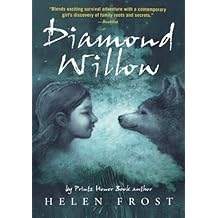
Frost, Helen. Diamond Willow. New York: Frances Foster Books, 2008. ISBN 9781466896345 2008
Plot Summary:
The setting for this story is a small, remote city in Alaska without modern forms of transportation. Snowmobile or sledding are the only available modes of transportation. Willow is allowed for the first time to go to her grandparents house by dog sled. She bravely attempts the journey which leads to an accident the injures the family's beloved dog, Roxy. To prevent Roxy from being euthanized, Willow must face her fears on a journey to the safety of her grandparent's home.
The setting for this story is a small, remote city in Alaska without modern forms of transportation. Snowmobile or sledding are the only available modes of transportation. Willow is allowed for the first time to go to her grandparents house by dog sled. She bravely attempts the journey which leads to an accident the injures the family's beloved dog, Roxy. To prevent Roxy from being euthanized, Willow must face her fears on a journey to the safety of her grandparent's home.
Critical Analysis:
Frost has created diamond shapes throughout this poetic story. The shapes go along with the main characters name, Diamond Willow. In the first few pages, Frost describes how the main character received the name Diamond Willow: "I was named after a stick....Daddy found a small stand of diamond and willow and brought home one stick. Let's name our baby Diamond Willow!"
Some of the words are in bold font to tell the main thought of each passage. Throughout the story, Frost has carefully incorporated thoughts from past family members via animal thoughts. She uses a Fox to be the voice of John, Willow's great-great-grandfather.
There is a huge emotional impact to this story that most readers can connect with. Frost does an amazing job of describing Diamond Willow's twin sister's death. Frost says, "She picked me up. She checked to see if I was breathing. In the morning, Willow woke, but I did not." It will bring any mother to tears reading that line. A mother could connect with losing a child and a young student can connect with trying to be brave during his/her young years of life. The language in this story is easy to follow and Frost has chosen descriptive vocabulary words to help the reader feel like they are snow sledding with Willow.
Frost has created diamond shapes throughout this poetic story. The shapes go along with the main characters name, Diamond Willow. In the first few pages, Frost describes how the main character received the name Diamond Willow: "I was named after a stick....Daddy found a small stand of diamond and willow and brought home one stick. Let's name our baby Diamond Willow!"
Some of the words are in bold font to tell the main thought of each passage. Throughout the story, Frost has carefully incorporated thoughts from past family members via animal thoughts. She uses a Fox to be the voice of John, Willow's great-great-grandfather.
There is a huge emotional impact to this story that most readers can connect with. Frost does an amazing job of describing Diamond Willow's twin sister's death. Frost says, "She picked me up. She checked to see if I was breathing. In the morning, Willow woke, but I did not." It will bring any mother to tears reading that line. A mother could connect with losing a child and a young student can connect with trying to be brave during his/her young years of life. The language in this story is easy to follow and Frost has chosen descriptive vocabulary words to help the reader feel like they are snow sledding with Willow.
Review Excerpts:
2008 Mitten Award
2008 Mitten Award
From School Library Journal: This complex and elegant novel will resonate with readers who savor powerful drama and multifaceted characters."
From Booklist: "Set in a remote part of Alaska, this story in easy-to-read verse blends exciting surival adventure with a contemporary girl's discovery of family roots and secrets."
From Richie's Picks: "As it takes us gliding along on a dogsled with Willow into the depths of the snowy Alaskan interior, Diamond Willow illustrates oneness, forgiveness, joyfulness, and how a child can sometimes each her parents well."
Connections:
Have your students create their object poems.
Discuss writing in different voices and read Helen's Frost Spinning through The Universe.
Research about town, Telida, Alaska where Frost lived before writing Diamond Willow.
*All images are from Amazon.com


Comments
Post a Comment