Genre Two: Traditional Literature
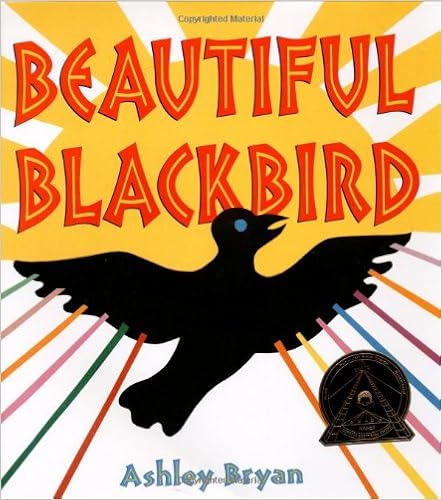
Beautiful Blackbird by Ashley Bryan
Bibliography: Bryan, Ashley. Beautiful Blackbird. New York: Atheneum Books for Young Readers, 2003. ISBN 978-0689847318
Plot Summary:
In Africa, all the birds were beautiful colors. There was only one bird who stood out among the rest and his name was, Blackbird. The birds thought his color was beautiful because he was the only one that was black. They ask Blackbird if he would help paint them black because they want to look like that also. Blackbird makes black in his medicine gourd and painted Ringdove with beautiful black markings. After Blackbird was done painting other birds wanted to be painted too. The next day, Blackbird brought his last bit of black and stirred it up while he said, " We'll see the difference a touch of black can make. Just remember, whatever I do, I'll be me, and you'll be you." The birds are excited to have their new markings of black and surround Blackbird and sing how beautiful black is.
Critical Analysis:
A Beautiful Blackbird is read like a song. The words encourage you to have a rhythm in your voice. The pictures in A Beautiful Blackbird are remarkable. The birds themselves are very simply drawn, but convey so much within the story. The pictures reflect the story of the African tale. The setting is around water and trees with birds of different colors, shapes, and sizes. There is a strong pattern that Bryan is able to convey to the readers. Bryan's words help the birds come to life as the reader turns each page. Bryan's message and theme is easily seen with, "Color on the outside, is not what's on the inside." This theme signifies that we should celebrate everyone's own unique qualities.
Review Excerpts:
Coretta Scott King Illustrator Award
From Publisher's Weekly: "Storyteller Bryan's singular voice provides rhythm and sound effects throughout this musical adaptation of a Zambian tale."
From Hornbook: "Bryan, at the age Matisse was when he did his late, great cut-paper compositions for Jazz, has made what is more fully a picture book than anything he's done before in a medium he's hardly used before."
Connections:
The teacher or librarian could read other folktale books to the class:
Let it Shine by Ashley Bryan
How Tiger Got His Stripes by Rob Cleveland
The Drum: A Folktale from India by Rob Cleveland
Discuss what the word 'beautiful' means to you and discuss how everyone is uniquely beautiful in their own way.
Art:
They could draw a picture of what they think they look like and their partner could draw what they look like to them.
Students could create their own blackbirds out of construction paper and paint.
Bibliography:
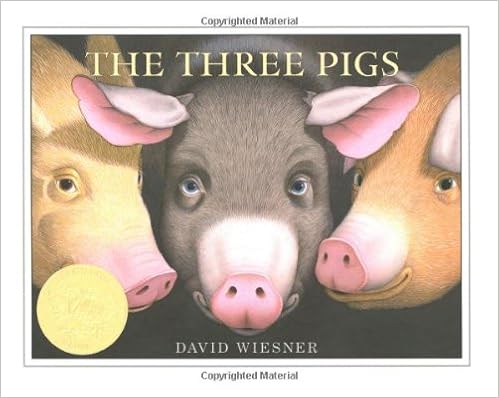
Wiesner, David. The Three Little Pigs. New York: Clarion Books, 2001. ISBN 9780618007011
Plot Summary:
Three little pigs set off to build their own houses made from different materials. The first pig makes his house of straw. A wolf comes by and "huffs and puffs" his house down and blows so hard that the pig is thrown out of the story! The second pig builds his house out of sticks and suffers the same fate as the first pig. The third pig becomes clever and makes a paper airplane out of the storybook pages and takes his brothers on a trip through other famous nursery rhymes. They rescue a dragon just in time to bring him to their own brick house. The wolf comes by the third pig's house and tries to "huff and puff" the house down, but is not successful because the dragon pokes his head out the door to scare him. The pigs all end up happy in their house eating dinner together with their new friends.
Critical Analysis:
David Wiesner creates a playful recreation of the traditional tale of The Three Little Pigs. The plot line is predictable in the beginning, but Wiesner surprises us with the little pig flying on a story page paper airplane and whizzing through various famous stories. This plot twist captures the attention of both young and old readers. Wiesner is able to change the story with a dramatic twist, while maintaining the global message of the story. The pig that worked the hardest and chose the best house material wins.
Wiesner helps create the imaginative story through his descriptive illustrations. When the pigs begin to fly, Wiesner uses the white space to make the characters pop with his detailed drawings of the pigs and story pages. It excites any reader to want to know what happens next. His drawings are what helps the reader understand what is truly happening in the story; that the pigs are flying in to the other nursery rhymes while using the pages of the story.
Review Excerpts:
2002 CALDECOTT MEDAL
From School Library Journal: "Children will delight in the changing perspectives...and the whole notion of the interrupted narrative....fresh and funny...witty dialogue and physical comedy abound in this inspired retelling of a familiar favorite."
From New York Times: "Wiesner's dialogue and illustrations are clever, whimsical and sophisticated."
From Booklist: Wiesner has created a funny, wildly imaginative tale that encourages readers to leap beyond the familiar; to think critically about conventional stories and illustration, and perhaps, to flex their imaginations and create wonderfully subversive versions of their own stories."
Connections:
Read other variations of The Three Little Pigs:
The True Story of the 3 Little Pigs by Jon Scieszka
The Three Little Pigs and the Somewhat Bad Wolf by Mark Teague
Discuss Questions:
Why do you think the wolf wanted to blow their houses down?
Why was the 3rd pig the most successful?
Do you think the Wolf would have tried the other two pigs if the first pig had built his house out of brick?
Art Lesson:
Try to build a sculpture with Popsicle sticks. See how hard it is to blow it down with your breath. Try to build a sculpture with toothpicks and marshmallows. Can you see the difference?

Bibliography:
Pinkney, Jerry. (Adapted). The Ugly Duckling. New York: HarperCollins Publishers, 1999. ISBN 9780688159320
Plot Summary:
A mother duck is watching her eggs very closely when she sees that one egg looks a little bit different than the others, she thinks nothing of it and continues to wait for them to hatch. One by one, the birds hatch, but the oddly shaped egg takes a little bit longer. Finally, out comes her last baby and he looks much different than his other siblings. Several other ducks (even his brothers and sisters) start teasing him for his different looks, but the mother defends her baby chick. However, he can't stand it any longer and he escapes in the middle of the night. He meets many animals along his walk to escape, but never feels like he fits in or is wanted anywhere. One day it becomes very cold and he gets trapped in icy water. He is rescued by a man and his family. The winter was hard and cold, but finally spring came and the duck decided to follow a group of beautiful birds into the water. He hears the children talking and looks in his reflection and realizes he has turned into a beautiful swan.
A mother duck is watching her eggs very closely when she sees that one egg looks a little bit different than the others, she thinks nothing of it and continues to wait for them to hatch. One by one, the birds hatch, but the oddly shaped egg takes a little bit longer. Finally, out comes her last baby and he looks much different than his other siblings. Several other ducks (even his brothers and sisters) start teasing him for his different looks, but the mother defends her baby chick. However, he can't stand it any longer and he escapes in the middle of the night. He meets many animals along his walk to escape, but never feels like he fits in or is wanted anywhere. One day it becomes very cold and he gets trapped in icy water. He is rescued by a man and his family. The winter was hard and cold, but finally spring came and the duck decided to follow a group of beautiful birds into the water. He hears the children talking and looks in his reflection and realizes he has turned into a beautiful swan.
Critical Analysis:
Pinkney's adaptation of the Hans Christian Anderson's folktale is beautifully written. The mood of this story is set by Pinkney's tone and the descriptive water color illustrations used. When his brothers and sisters are watching the ugly duck hatch, the detail on their faces clearly emphasizes the shock and digust experienced by the characters.
The plot is so realistic that most children can easily make life connections with this story. Pinkney is able to tell a story about a duck that most people can relate to in their own lives. Although, younger children may not completely understand the underlying theme and life lesson, this book is a must read for all ages.
Pinkney's adaptation of the Hans Christian Anderson's folktale is beautifully written. The mood of this story is set by Pinkney's tone and the descriptive water color illustrations used. When his brothers and sisters are watching the ugly duck hatch, the detail on their faces clearly emphasizes the shock and digust experienced by the characters.
The plot is so realistic that most children can easily make life connections with this story. Pinkney is able to tell a story about a duck that most people can relate to in their own lives. Although, younger children may not completely understand the underlying theme and life lesson, this book is a must read for all ages.
Review Excerpts:
2000 CALDECOTT WINNER
From Publishers Weekly: "The simplified telling here may be more palatable to younger readers, but it flattens the story, making what was poetic stiff and what was funny too protracted."
From Children's Literature: "This picture book edition of one of Hans Christian Anderson's most memorable tales is perfectly suited to the older reader."
From Kirkus Reviews: "Outstanding illustrations and some new characters make Pinkney's retelling of a familiar tale memorable."
Connections:
Have students write an alternate ending to the story.
Create a Reader's theater show to this book. Have students act out the various parts of the story.
*All pictures are from Amazon


Comments
Post a Comment