Genre Four- NonFictio and Biography
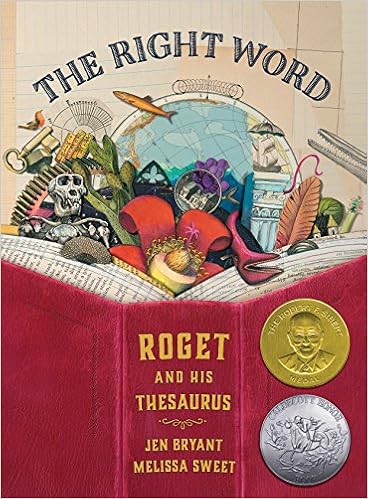
Bibliography:
Bryant, Jen. Roget and His Thesaurus. By Melissa Sweet. Grand Rapids: William B. Publishing, 2014. ISBN 9780802853851
Bryant, Jen. Roget and His Thesaurus. By Melissa Sweet. Grand Rapids: William B. Publishing, 2014. ISBN 9780802853851
Plot Summary:
This is the life story of Peter Roget and the history of the first thesaurus. As a young child, Peter loses his father and moves frequently. He takes comfort in reading and making word lists. His word lists continue to get so large that he turns his lists into a book and calls it a thesaurus.
Critical Analysis:
Bryan has created an accurate portrayal of the life and journey Peter Roget took to create his famous book, the Thesaurus. One of the first pages has a detailed picture timeline of Roget's infancy to his death. Bryan cleverly used all synonyms to showcase this unique record. It is easy to see Bryant and Sweet studied the life of Roget before beginning their story. Sweet says,"The words and pictures had to be intertwined. I crafted the content of the lists to reflect his age at the time, the setting, what he was studying."
The reader can also get a sense of who Roget was when he first decided to think about making lists. He is having a conversation with his mother when she always asks him about his day. His typical response was always 'fine.' Although, to be honest, Peter thought, fine wasn't quite the right word."
All of the pictures were carefully calculated to correspond with Bryant's journey of creating his book. Sweet uses pieces of scientific papers to show how he would use words. The illustrations grab the reader's attention and shows Roget's love for words and their order. There is a clear and logical layout to this book. Bryant's style encourages curiosity and would also encourage a student to go pick up a thesaurus.
The reader can also get a sense of who Roget was when he first decided to think about making lists. He is having a conversation with his mother when she always asks him about his day. His typical response was always 'fine.' Although, to be honest, Peter thought, fine wasn't quite the right word."
All of the pictures were carefully calculated to correspond with Bryant's journey of creating his book. Sweet uses pieces of scientific papers to show how he would use words. The illustrations grab the reader's attention and shows Roget's love for words and their order. There is a clear and logical layout to this book. Bryant's style encourages curiosity and would also encourage a student to go pick up a thesaurus.
Review Excerpts:
2015 CALDECOTT Honor Book
2015 Sibert Medal Winner
From Publishers Weekly: Bryant draws a clear line from the dislocations of Roget's youth-the death of his father in 1783 and the family's frequent moves thereafter--to his need for order as he starts making lists of words."
From The New York Times: "Jen Bryant and Melissa Sweet have done their homework and considered their audience. The narrative moves swiftly...Sweet's richly layered graphic frame the basic narrative drawings in collaged bits and pieces of calligraphy, antique engraving, archival maps, bookbinding remnants and other evocative oddments that collectively provide an attic-glimpse into the mind of a restless man whose vast vocabulary could barely keep pace with his curiosity."
Connections:
Introduce students to a thesaurus. Have them look up words they would like to.
Discuss timelines. Have students draw or bring in pictures from home and create their own timeline.
http://blaine.org/sevenimpossiblethings/?p=3452#more-3452
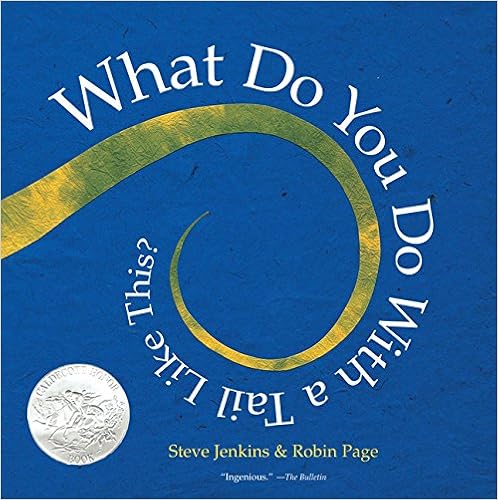
Bibliography:
Jenkins, Steve and Robin Page. What do you do with a Tail like this? Boston: Houghton Mifflin Harcourt, 2008. ISBN 9780618997138
Plot Summary:
Jenkins and Page lead you on an informational story of several different animals and what they use their ears, noses, and tails for. Jenkins and Page encourage the reader to guess whose tail is whose before the reader can turn the page to find out.
Critical Analysis:
What do you do with a Tail like this is a very accurate and informative way to explain the uses of animal's body parts to young children. Jenkins, who initially wanted to be a scientist, began writing non fiction books when he had his first child. Jenkins stated," I believe we should teach science as a process not just a collection of facts. It's a tool that allows children to test their own theories and to trust their own conclusions" (Auerbach, 2012).
The authors use animals that most children are familiar with which makes them excited to learn more. Jenkins and Page have an easy to understand introduction to the concept of the book, "See if you can guess which animal each part belongs to." There is also a picture dictionary at the end of the book. All of the illustrations and text match up with the correct information.
There is a logical layout of this book with a clear pattern. The first page says, "What do you do with a nose like this?" The reader turns the page to discover all of the noses and their jobs. "If you're a hyena, you find your next meal with your nose."
The design of the book is inviting because the pictures are simple and the text is right around the pictures. It is easy to the eye to see and not too busy. The illustrations are amazing and all of the animals were given a lot of detail. My favorite is the upside down gecko!
Review Excerpts:
2004 CALDECOTT AWARD
From Booklist: "This is a striking, thoughtfully created book with intriguing facts made more memorable through dynamic art."
From Kirkus Reviews: "....this array of wide eyes and open mouths will definitely have viewers responding with wide eyes and open mouths of their own."
From Publishers Weekly: "Steve Jenkins contributes another artistically wrought, imaginatively conceived look at the natural world."
Connections:
Students can make their own picture dictionary book with animals they know.
You could do a research project on one of the animals shown.
Read more Steve Jenkins books:
Biggest, Strongest, Fastest
How many ways can you catch a fly?
Auerbach, Barbara. "The Wild World of Steve Jenkins." School library Journal. (October 2012): accessed March 20, 2018, https://www.slj.com/2012/10/books-media/the-wild-world-of-steve-jenkins-an-author-study/#_
Fleming, Candace. The Family Romanov. New York: Random House, 2014. ISBN 9780375867828
Plot Summary:
Nicholas was raised by his Tsar father in Russia. He was never taught to be a Tsar because his father did not think it was important. Nicholas grew up and married Alexandra and ultimately became the Tsar of Russia. However, he did not want to take charge of any issues and hid away with his family. When problems began to arise, Nicolas tried to unsuccessfully stop them. This ultimately led to the Romanov's defeat and execution.
Critical Analysis:
Fleming's portrayal of the Romanov family is very accurate and also includes actual photographs that go along with each chapter of this non fiction book. In the back of the book is a question and answer with Candace Fleming. She states how she began her research and found her factual information. Fleming states, "I was aware of the facts surrounding their murder. After some reading and research, I came to realize that I needed to find out how did this happen?" This puts the reader at ease knowing the story they have just read is very specific to the story and time period.
Fleming's layout of this book is easy to follow with several different sections listed with a detailed Table of Contents. The subheadings also include a small excerpt of what is to come. The family tree is also helpful for someone newly introduced to the Romanov family. Her "Before You Begin" section is very helpful to learn key Russian vocabulary words.
The authentic photographs in the book help depict the portrayal of this heartbreaking story of love, betrayal, and murder. I appreciated the photographs Fleming adds at the end after you have read the story.
The Romanov story in the beginning is a wonderful love story and I think Fleming does a great job of depicting that. The reader will begin to care for the family and the children. Fleming shows that Nicholas and Alexandra were doting parents by stating, "they climbed into the playpen and played with their daughter!" It is also heart wrenching to read when they finally have their long awaited son that he is ill with hemophilia and the pain they endure to hide his illness.
Fleming encourages critical thinking as you are introduced to several characters that you have heard of in your life (Rasputin). This book is gripping with new and old information about this intriguing famous family. I could not put it down!
Review Excerpts:
Golden Kite Award for Nonfiction
Robert F. Sibert Nonfiction Honor Book
From Publishers Weekly: "Making vibrant use of primary sources that emerged since the collapse of the Soviet Union in 1991, Fleming brings to life the last imperial family of Russia.
From Kirkus Reviews: "Fleming examines the family at the center of two of the early 20th century's defining events. It's an astounding and complex story, and Fleming lays it neatly out for readers unfamiliar with the context."
Connections:
Have students do a research project on the Romanov family.
Discuss what has changed in Russia in the last 100 years.
Discuss World War I with students and have them talk about different perspectives from each side.
Jenkins, Steve and Robin Page. What do you do with a Tail like this? Boston: Houghton Mifflin Harcourt, 2008. ISBN 9780618997138
Plot Summary:
Jenkins and Page lead you on an informational story of several different animals and what they use their ears, noses, and tails for. Jenkins and Page encourage the reader to guess whose tail is whose before the reader can turn the page to find out.
Critical Analysis:
What do you do with a Tail like this is a very accurate and informative way to explain the uses of animal's body parts to young children. Jenkins, who initially wanted to be a scientist, began writing non fiction books when he had his first child. Jenkins stated," I believe we should teach science as a process not just a collection of facts. It's a tool that allows children to test their own theories and to trust their own conclusions" (Auerbach, 2012).
The authors use animals that most children are familiar with which makes them excited to learn more. Jenkins and Page have an easy to understand introduction to the concept of the book, "See if you can guess which animal each part belongs to." There is also a picture dictionary at the end of the book. All of the illustrations and text match up with the correct information.
There is a logical layout of this book with a clear pattern. The first page says, "What do you do with a nose like this?" The reader turns the page to discover all of the noses and their jobs. "If you're a hyena, you find your next meal with your nose."
The design of the book is inviting because the pictures are simple and the text is right around the pictures. It is easy to the eye to see and not too busy. The illustrations are amazing and all of the animals were given a lot of detail. My favorite is the upside down gecko!
Review Excerpts:
2004 CALDECOTT AWARD
From Booklist: "This is a striking, thoughtfully created book with intriguing facts made more memorable through dynamic art."
From Kirkus Reviews: "....this array of wide eyes and open mouths will definitely have viewers responding with wide eyes and open mouths of their own."
From Publishers Weekly: "Steve Jenkins contributes another artistically wrought, imaginatively conceived look at the natural world."
Connections:
Students can make their own picture dictionary book with animals they know.
You could do a research project on one of the animals shown.
Read more Steve Jenkins books:
Biggest, Strongest, Fastest
How many ways can you catch a fly?
Auerbach, Barbara. "The Wild World of Steve Jenkins." School library Journal. (October 2012): accessed March 20, 2018, https://www.slj.com/2012/10/books-media/the-wild-world-of-steve-jenkins-an-author-study/#_
Fleming, Candace. The Family Romanov. New York: Random House, 2014. ISBN 9780375867828
Plot Summary:
Nicholas was raised by his Tsar father in Russia. He was never taught to be a Tsar because his father did not think it was important. Nicholas grew up and married Alexandra and ultimately became the Tsar of Russia. However, he did not want to take charge of any issues and hid away with his family. When problems began to arise, Nicolas tried to unsuccessfully stop them. This ultimately led to the Romanov's defeat and execution.
Critical Analysis:
Fleming's portrayal of the Romanov family is very accurate and also includes actual photographs that go along with each chapter of this non fiction book. In the back of the book is a question and answer with Candace Fleming. She states how she began her research and found her factual information. Fleming states, "I was aware of the facts surrounding their murder. After some reading and research, I came to realize that I needed to find out how did this happen?" This puts the reader at ease knowing the story they have just read is very specific to the story and time period.
Fleming's layout of this book is easy to follow with several different sections listed with a detailed Table of Contents. The subheadings also include a small excerpt of what is to come. The family tree is also helpful for someone newly introduced to the Romanov family. Her "Before You Begin" section is very helpful to learn key Russian vocabulary words.
The authentic photographs in the book help depict the portrayal of this heartbreaking story of love, betrayal, and murder. I appreciated the photographs Fleming adds at the end after you have read the story.
The Romanov story in the beginning is a wonderful love story and I think Fleming does a great job of depicting that. The reader will begin to care for the family and the children. Fleming shows that Nicholas and Alexandra were doting parents by stating, "they climbed into the playpen and played with their daughter!" It is also heart wrenching to read when they finally have their long awaited son that he is ill with hemophilia and the pain they endure to hide his illness.
Fleming encourages critical thinking as you are introduced to several characters that you have heard of in your life (Rasputin). This book is gripping with new and old information about this intriguing famous family. I could not put it down!
Review Excerpts:
Golden Kite Award for Nonfiction
Robert F. Sibert Nonfiction Honor Book
From Publishers Weekly: "Making vibrant use of primary sources that emerged since the collapse of the Soviet Union in 1991, Fleming brings to life the last imperial family of Russia.
From Kirkus Reviews: "Fleming examines the family at the center of two of the early 20th century's defining events. It's an astounding and complex story, and Fleming lays it neatly out for readers unfamiliar with the context."
Connections:
Have students do a research project on the Romanov family.
Discuss what has changed in Russia in the last 100 years.
Discuss World War I with students and have them talk about different perspectives from each side.


Comments
Post a Comment