Genre One: Picture Books

Photo from Amazon.com
Bibliography:
Mattick,
Lindsay. Finding Winnie: The
True Story of the World's Most Famous Bear. by Sophie Blackall. New York: Little Brown and Company, 2015. ISBN 9780316324908
Plot
Summary:
Cole is getting ready for his bedtime when he asks his mother to tell him a story. She tells him a story of Harry Colebourn who is a veterinarian. Harry loves animals and cares for his horses, but he has to go off to the war and leave them behind. On his train journey for the war, he stops and sees a baby bear with a trapper. He offers the trapper 20 dollars to keep the baby bear cub. The other men in Harry's regiment are skeptical, but they accept the bear cub. Harry decides to name him, "Winnie" which is short for Winnipeg (his home). As the war goes on, Winnie keeps getting bigger and bigger. They even take Winnie across the Atlantic Ocean to England. When it was finally time for the men to go to Battle, Harry knew he couldn't possibly bring Winnie with him. With a heavy heart, he brought her to the London Zoo so they could care for her.
The next part of the story begins with a little boy (Christopher Robin) playing with his unnamed stuffed teddy bear. His father takes him to the London Zoo where they meet the bear, Winnie. Christopher falls in love with Winnie and plays with him inside his cage at the zoo. He ultimately names his teddy bear, Winnie the Pooh. His father, A Alan Milne writes books about their adventures together with Winnie.
When Harry Colebourn returns from the war, he is happy that Winnie has been taken care of and he returns to Winnipeg to return to his veterinary practice and a family. His great great grandson is Cole.
Critical
Analysis:
Lindsay Mattick descriptively tells the true story of the classic, Winnie The Pooh. The author's emotional tone is felt throughout the story through her words and pictures. Harry's character stands out in the book because he did the unthinkable. He kept a bear cub as a pet. Not only did he keep it as a pet, but he traveled around the world with him.
The watercolor illustrations by Sophie Blackall captivate the reader. The author also includes actual photographs from Harry Colebourn's time in the war and with Winnie. This adds a unique dynamic to the story. The illustrations in this story also really affect the mood. When Harry is going through the war times, the illustrator depicts soldiers trudging through the rain. She was able to captivate that emotional moment on one page.
Review
Excerpts:
2016
CALDECOTT AWARD
New
York Times Notable Children's Book of the Year
Publishers
Weekly Best Book of the Year
From Horn Book: "The sum total is as
captivating as it is informative, transforming a personal family story into
something universally resonant."
From School Library Journal: "A perfect
melding of beautiful art with soulful, imaginative writing, this lovely story,
penned by Colebourn's great-great granddaughter, is ideal for sharing aloud or
poring over individually."
Connections:
Art
lesson: Have students draw a picture of a bear that they might want to have as
a pet. What is their name?
Read
the original Winnie the Pooh books
by A.A. Milne. Discuss what you notice about the two books.
Science:
Discuss the issue of endangered bears. What can you do to help this ongoing
problem?

Photo from Amazon.com
Are
You My Mother? By P.D. Eastman
Bibliography:
Eastman, P.D. Are You My Mother? New York: Random House, 1960. ISBN 0679890475
Plot Summary:
This is a story of a baby bird who comes out of his shell to see that his mother is not there. The bird decides to go look for his mother. When he falls out of his nest he realizes he cannot fly, so he walks to try to find her. He runs into many different animals on the way and asks them, "Are you my mother?" Ultimately, the bird comes across a bulldozer who lifts him up and places him back in his nest. His mother then returns back to the nest with a worm for the baby bird.
Critical Analysis:
Eastman captures the readers attention by beginning the book with a baby bird about to hatch. She cleverly spaces her pictures and words in a certain way to go along with the story. The reader can almost hear the bird fall when Eastman uses onomatopoeia with the word, "Plop!" She also emphasizes several words to encourage the reader to also emphasize them when reading. The illustrations help the story move along. The drawings use lines to highlight the various characters seen throughout the story.
Review Excerpts:
Top 100 Books for Children: National Education AssociationTop 100 Picture Storybooks: School Library Journal Elizabeth Bird from School Library Journal: "Which, to my mind, rather than rendering the book awful makes it FRIGGIN’ AWESOME to consider. Somebody turn this puppy into a YA novel and I’ll guarantee the millions. Maybe."
Connections:
Read Does a Kangaroo Have a Mommy Too? ISBN 006443642X by Eric Carle and discuss the similarities and differences
Discuss P.D. Eastman's working friendship with Dr. Seuss
Integrate science and discuss birds by reading P.D. Eastman's other books about birds:
The Best Nest, 978-0394800516
My Nest is Best, 978-0375832673 and
Flap your Wings. 978-0375802430
Bibliography:
Eastman, P.D. Are You My Mother? New York: Random House, 1960. ISBN 0679890475
Plot Summary:
This is a story of a baby bird who comes out of his shell to see that his mother is not there. The bird decides to go look for his mother. When he falls out of his nest he realizes he cannot fly, so he walks to try to find her. He runs into many different animals on the way and asks them, "Are you my mother?" Ultimately, the bird comes across a bulldozer who lifts him up and places him back in his nest. His mother then returns back to the nest with a worm for the baby bird.
Critical Analysis:
Eastman captures the readers attention by beginning the book with a baby bird about to hatch. She cleverly spaces her pictures and words in a certain way to go along with the story. The reader can almost hear the bird fall when Eastman uses onomatopoeia with the word, "Plop!" She also emphasizes several words to encourage the reader to also emphasize them when reading. The illustrations help the story move along. The drawings use lines to highlight the various characters seen throughout the story.
Review Excerpts:
Top 100 Books for Children: National Education AssociationTop 100 Picture Storybooks: School Library Journal Elizabeth Bird from School Library Journal: "Which, to my mind, rather than rendering the book awful makes it FRIGGIN’ AWESOME to consider. Somebody turn this puppy into a YA novel and I’ll guarantee the millions. Maybe."
Connections:
Read Does a Kangaroo Have a Mommy Too? ISBN 006443642X by Eric Carle and discuss the similarities and differences
Discuss P.D. Eastman's working friendship with Dr. Seuss
Integrate science and discuss birds by reading P.D. Eastman's other books about birds:
The Best Nest, 978-0394800516
My Nest is Best, 978-0375832673 and
Flap your Wings. 978-0375802430
Photo
from Amazon.com
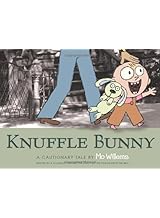
Knuffle Bunny, by Mo Willems
Bibliograpy: Willems, Mo. Knuffle Bunny. New York: Hyperion Books for Children, 2004. ISBN 9780786818709
Plot Summary:
Trixie is a little girl who is going to the laundromat with her father. They pass a school and a park on their walk. Trixie assists her dad in helping load the washing machine with the dirty clothes. Then, they are on the way home. However, on the way home Trixie realizes that she has lost her precious lovie, "Knuffle Bunny." Since Trixie is a young child she is unable to communicate with her father so she just cries the entire walk home. When they get to the house, Trixie's mommy knows right away that "Knuffle Bunny" is missing. They race back to the laundromat and go the same way, past the park and school. They look everywhere for Knuffle Bunny and her dad finally finds him inside the washing machine. Trixie says her first words, "Knuffle Bunny."
Critical Analysis:
Willems captivates children with the story of Knuffle Bunny. The character, Trixie is a relatable little girl who is going on a typical errand with her father. Children can relate to her as she loses her beloved, "Knuffle Bunny." Willems uses actual photographs to set the setting throughout the book to help describe the story. The experienced reader can see that Trixie lives in the city based on the photograph of the building and their use of the laundromat. Willems also uses lines in his illustrations. All of his characters are outlined in a black line. This balances well with his choice of bright colors.
Review Excerpts:
2005 CALDECOTT AWARD
From Publishers Weekly: "Willems creates an entertaining story for parents and children alike and once again demonstrates his keen insight with a story both witty and wise."
From Common Sense Media: "A charming book for all ages."
From Horn Book: "Williams gets everything just right, from the familiarity of the everyday drama to the heightened focus of the illustrations, in which cartoon characters practically burst out of their sepia-toned photo backgrounds."
Connections:
Read the sequels to "Knuffle Bunny:
- Knuffle Bunny Too: A case of Mistaken Identity
- Knuffle Bunny Free: An Unexpected Diversion
Extend the lesson to language arts and discuss the use of speech bubbles.


Comments
Post a Comment